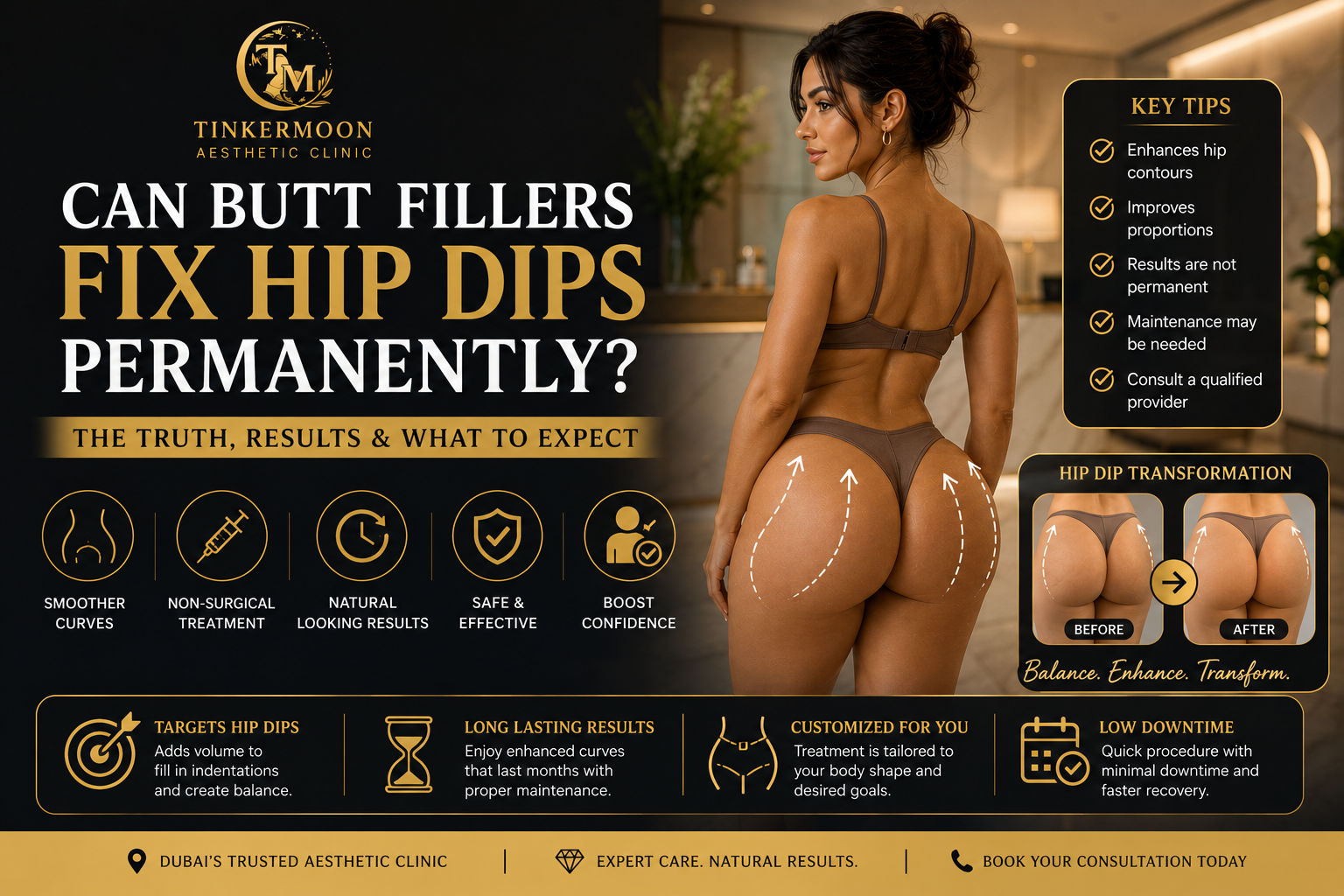
Hip dips are one of the most common body contour concerns discussed during aesthetic consultations. Many patients who are considering butt fillers ask an important question: Can butt fillers fix hip dips permanently?
While butt fillers may significantly improve the appearance of hip dips and create smoother body contours, it is important to understand how the treatment works, how long results may last, and whether permanent correction is possible.
In this guide, we’ll explain the relationship between butt fillers and hip dips, what affects treatment longevity, who may be a suitable candidate, and what patients should realistically expect before treatment in Dubai.
What Are Hip Dips?
Hip dips are the natural inward curves that appear between the hips and upper thighs. They are a normal anatomical feature caused by bone structure, muscle shape, fat distribution, and genetics.
Some people have very noticeable hip dips, while others have minimal indentation. Hip dips are not considered a medical problem, but many patients seek cosmetic enhancement to achieve smoother body contours.
Because hip dips are largely influenced by anatomy, exercise alone may not completely eliminate their appearance.
| Factor | Influence on Hip Dips |
|---|---|
| Pelvic structure | Major anatomical factor |
| Muscle shape | Affects contour appearance |
| Fat distribution | Influences visibility |
| Genetics | Determines natural body shape |
| Body composition | May affect prominence |
Why Do Hip Dips Happen?
Hip dips occur because of the natural spacing between the pelvis and upper thigh bones. The skin and soft tissue follow this underlying structure, creating an inward curve.
Even individuals with low body fat, high muscle mass, or active lifestyles can have visible hip dips because the primary cause is skeletal anatomy.
This is why many patients seek contour enhancement rather than attempting to completely eliminate hip dips through exercise alone.
How Butt Fillers Improve Hip Dips
Butt fillers may help improve hip dips by strategically adding volume around the indentation area. This can create a smoother transition between the hips and thighs and improve overall body proportions.
The treatment focuses on contour enhancement rather than changing the underlying bone structure.
Many patients choose Butt Fillers in Dubai because they want non-surgical contour improvement with less downtime than surgical alternatives.
- Smoother hip contour
- Improved body proportions
- More balanced silhouette
- Reduced hip dip visibility
- Natural-looking enhancement
Can Butt Fillers Permanently Remove Hip Dips?
In most cases, butt fillers are not considered permanent treatments. While they may significantly improve the appearance of hip dips, the body gradually processes injectable products over time.
Results may last for extended periods depending on the filler type, metabolism, lifestyle, and individual body response, but maintenance treatments are commonly required.
Patients should understand that fillers improve the appearance of hip dips rather than permanently altering anatomy.
Those seeking permanent structural changes may need to discuss surgical options during consultation.
How Long Do Hip Dip Filler Results Last?
Longevity varies depending on multiple factors including product selection, metabolism, body composition, lifestyle habits, and treatment technique.
Some patients maintain results longer than others due to individual biological differences.
Learn more in How Long Do Butt Fillers Last in Dubai?.
What Factors Affect Longevity?
- Metabolism
- Exercise habits
- Body weight fluctuations
- Product type
- Injection technique
- Treatment area
- Maintenance sessions
- Individual body response
These variables make it impossible to predict identical results for every patient.
How Many Syringes May Be Needed?
The amount of filler required varies depending on hip dip depth, body proportions, treatment goals, and provider assessment.
Some patients require only modest contour enhancement while others may require a more comprehensive treatment plan.
Read more in How Many Syringes Are Needed for Butt Fillers?.
Who Is a Good Candidate for Hip Dip Fillers?
Good candidates are generally patients seeking non-surgical contour enhancement with realistic expectations.
- Mild to moderate hip dips
- Good overall health
- Stable body weight
- Realistic expectations
- Desire for non-surgical enhancement
Professional consultation remains the best way to determine treatment suitability.
Read more in Who Is a Good Candidate for Butt Fillers?.
Butt Fillers vs Fat Transfer for Hip Dips
| Feature | Butt Fillers | Fat Transfer |
|---|---|---|
| Surgery Required | No | Yes |
| Downtime | Typically shorter | Longer |
| Procedure Type | Injectable | Surgical |
| Recovery | Usually faster | More extensive |
| Body Fat Needed | No | Yes |
Each option has advantages and limitations. Consultation is necessary to determine which approach may best suit your goals.
Are Hip Dip Fillers Safe?
Safety depends on provider expertise, patient selection, product quality, and proper injection technique.
Patients should always choose qualified medical professionals and reputable clinics for injectable procedures.
Learn more in Are Butt Fillers Safe?.
Questions To Ask During Consultation
- Can fillers improve my specific hip dip shape?
- How many syringes may be required?
- How long might results last?
- Will maintenance treatments be needed?
- What recovery should I expect?
- What risks should I know about?
- Are there alternative treatments available?
Final Thoughts
Butt fillers can be an effective non-surgical option for improving the appearance of hip dips and creating smoother body contours. However, they are generally not considered a permanent solution because the body gradually processes injectable products over time.
The best treatment approach depends on your anatomy, goals, lifestyle, and expectations. Professional consultation is the most reliable way to determine whether hip dip fillers are suitable for you.
FAQ
Most butt filler treatments are not considered permanent. They may improve hip dip appearance, but maintenance sessions may be needed over time.
Yes. When treatment is properly planned, hip dip fillers can create smoother and more natural-looking body contours.
The amount varies depending on your anatomy, treatment goals, hip dip depth, and provider assessment.
Exercise may improve muscle tone, but it cannot completely change underlying bone structure, which is a major cause of hip dips.
Safety depends on product quality, provider expertise, injection technique, patient suitability, and proper treatment planning.
Recovery varies by patient, but temporary swelling, tenderness, or bruising may occur during the early healing stage.
It depends on your goals, anatomy, downtime preference, and medical suitability. Fillers are non-surgical, while fat transfer is a surgical option.
Good candidates are usually healthy patients with realistic expectations who want non-surgical contour improvement.